
maintaining a home
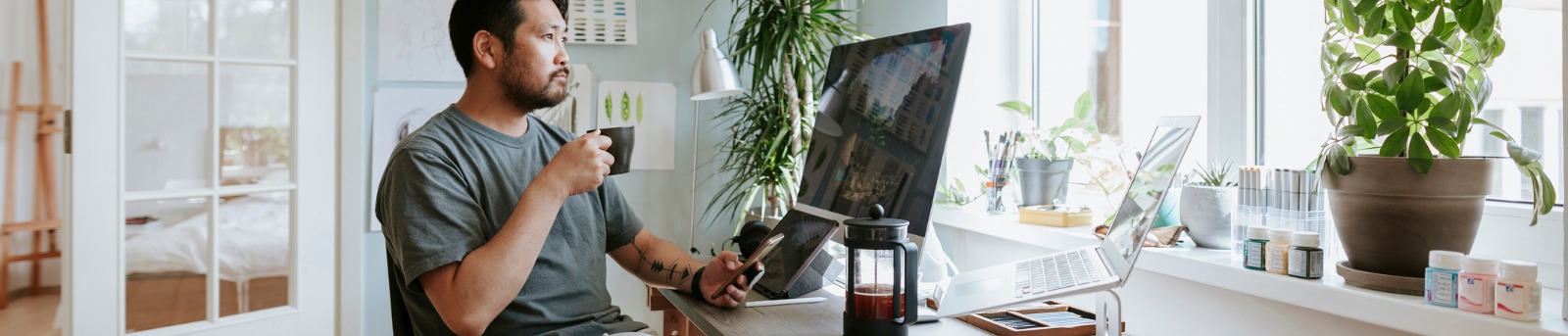
Nailing the perfect work from home setup
25 May 2026
Is it time to say goodbye to working at the kitchen table?
Having a dedicated workspace is a great way to prioritise your comfort and productivity while working from home. And while the costs involved can stack up, you may be able to claim a deduction on some of your initial and ongoing home setup expenses from your employer or the Australian Tax Office (ATO).
Setting up your workspace
Find the right space
Your work environment should be a productive one. Trying to take work calls from your couch might be fine for an hour or two, but it isn’t sustainable long-term.
Do you have a rarely used room or corner in your house? A guest room, garage, or space under your staircase? If so, see if you can repurpose it into a workspace.
Prioritise your safety and comfort
Ergonomics, comfort, and safety are essential to any work from home setup. To create a safe and pleasant place to work:
- Use cable organisers or simple cable ties to minimise trip hazards.
- Adjust your work surface, monitor and chair to the appropriate height.
- Use an ergonomic chair, sit-and-stand desk, or other equipment to elevate your comfort. Even a footstool or a well-placed cushion can help you remain comfortable during the workday.
- See if you can introduce some natural light to the space. If that isn’t possible, invest in some lighting. Through automation and colour changing options, smart bulbs adapt your home’s lighting to your daily routine.
- Place a few plants around your space to improve air quality. Snake plants aren’t just easy to care for – they also remove toxins from the air, according to NASA.
Don’t forget about your mental health
A good setup is one that boosts your mental wellbeing at work, so go ahead and decorate your space with things that make you feel good. Maybe that’s photos of your family, friends and pets, or maybe it’s a few pieces of art that spark your creativity.
Establishing boundaries between your work and living space can help reduce stress. Switching off and closing the door on your work at the end of the day can help. If you don’t have a door, you can make use of a divider to create a room within a room.
Know your employee benefits
Your employer is often responsible for ensuring your safety and wellbeing at work. If you’re an employee, find out whether your employer has an allowance for supplies like:
- ergonomic furniture
- monitors
- laptops
- stationery, and/or
- computer accessories.
They may be able to cover part or all of the cost of your home office.
Just remember: if you expense your costs through your employer, you cannot also claim for those costs in your tax return.
Understand what you can and can’t claim as a home office tax deduction
If you haven’t already claimed expenses through your employer, you may be able to claim a tax deduction for some of the expenses you incur in setting up your home office.
Determine your eligibility for home office deductions
Before you start claiming home office tax deductions, you need to determine your eligibility.
To claim working from home expenses, you must:
- be working from home to fulfil your employment duties (not just carrying out occasional tasks)
- incur additional running expenses because you work from home, and
- have records that show you incur these expenses, such as a receipt.
You can learn more about the eligibility criteria on the Australian Tax Office (ATO) website.
Types of deductible expenses
Once you've established your eligibility, you need to determine which expenses you can claim as deductions. There are two main types of deductible expenses: running and occupancy expenses.
Running expenses are what you incur while using your home office. Some common running expenses include:
- electricity and gas for heating and cooling
- internet and phone bills
- stationery and office supplies, and
- depreciation of home office equipment (such as laptops, ergonomic chairs and standing desks).
Occupancy expenses may include the following:
- rent
- mortgage interest
- property/land taxes, and
You might be wondering if you can claim home insurance on tax. The answer is yes, under certain conditions. It’s likely you won’t be able to recoup the full cost of your premium – the ATO will only reimburse you for the portion of your home that is devoted to business use. See the ATO website for more information on occupancy expenses.
You are only eligible to claim occupancy expenses if:
- it's necessary for you to work from home
- your employer has not offered you an alternative place to work, such as an office, and
- if you have a dedicated home office space in which you work (like a study, a repurposed garage or guest room).
If you are eligible to claim occupancy expenses, how much you can claim will depend on the size of your home office. You can learn more about what qualifies as occupancy expenses on the ATO's website.
Once you've determined which expenses you can claim as deductions, you need to calculate how much you can claim.
Calculating your running expenses
There are two methods you can use to calculate your home office running expenses.
- The actual cost method, which allows you to claim a deduction for the actual running costs you incur while using your home office, and,
- The ATO's fixed-rate method, which simplifies the calculation by allowing you to claim a set rate per working hour.
Always check the ATO website to check any updates on running expenses calculation.
Record keeping for home office deductions
To claim a home office tax deduction, you need to keep records of your expenses. Here's what you need to know about record keeping:
Supporting documentation
You need to keep supporting documentation for all of your home office expenses. This can include:
- receipts
- invoices
- bank statements, and
- a log of the time you spend in your home office for work.
Keep your records organised and stored securely. This can help you avoid problems if the ATO audits your tax return.
Ensure your calculations are accurate
Calculating your home office expenses can be complicated. It's important to get it right to avoid any issues with the ATO. To help you with your calculations, try using the ATO's home office expenses calculator.
If you are unsure about anything, seek professional financial advice.
Don't forget about insurance
After going to the effort and expense of setting up a home office, you might want to make sure your equipment is insured in the case of damage or theft.
Suncorp Home and Contents Insurance can cover home office equipment and more, including that new monitor and fancy standing desk. If you’re renting, consider Suncorp Contents Insurance. For full details of what’s included and excluded in your cover, please read the relevant Product Disclosure Statement (PDS).
Explore Suncorp Home and Contents Insurance
Read more:
Consult the Australian Taxation Office or your registered tax advisor to understand if the information is applicable to you or how they apply to your personal circumstances.
Insurance is issued by AAI Limited ABN 48 005 297 807 trading as Suncorp Insurance. Read the Product Disclosure Statement before buying this insurance. The Target Market Determination is also available. This advice has been prepared without taking into account your particular objectives, financial situations or needs, so you should consider whether it is appropriate for you before acting on it.
The information is intended to be of a general nature only. Subject to any rights you may have under any law, we do not accept any legal responsibility for any loss or damage, including loss of business or profits or any other indirect loss, incurred as a result of reliance upon it – please make your own enquiries.